
Scorpion
Not all Northampton marques originated in the first half of the 20th century
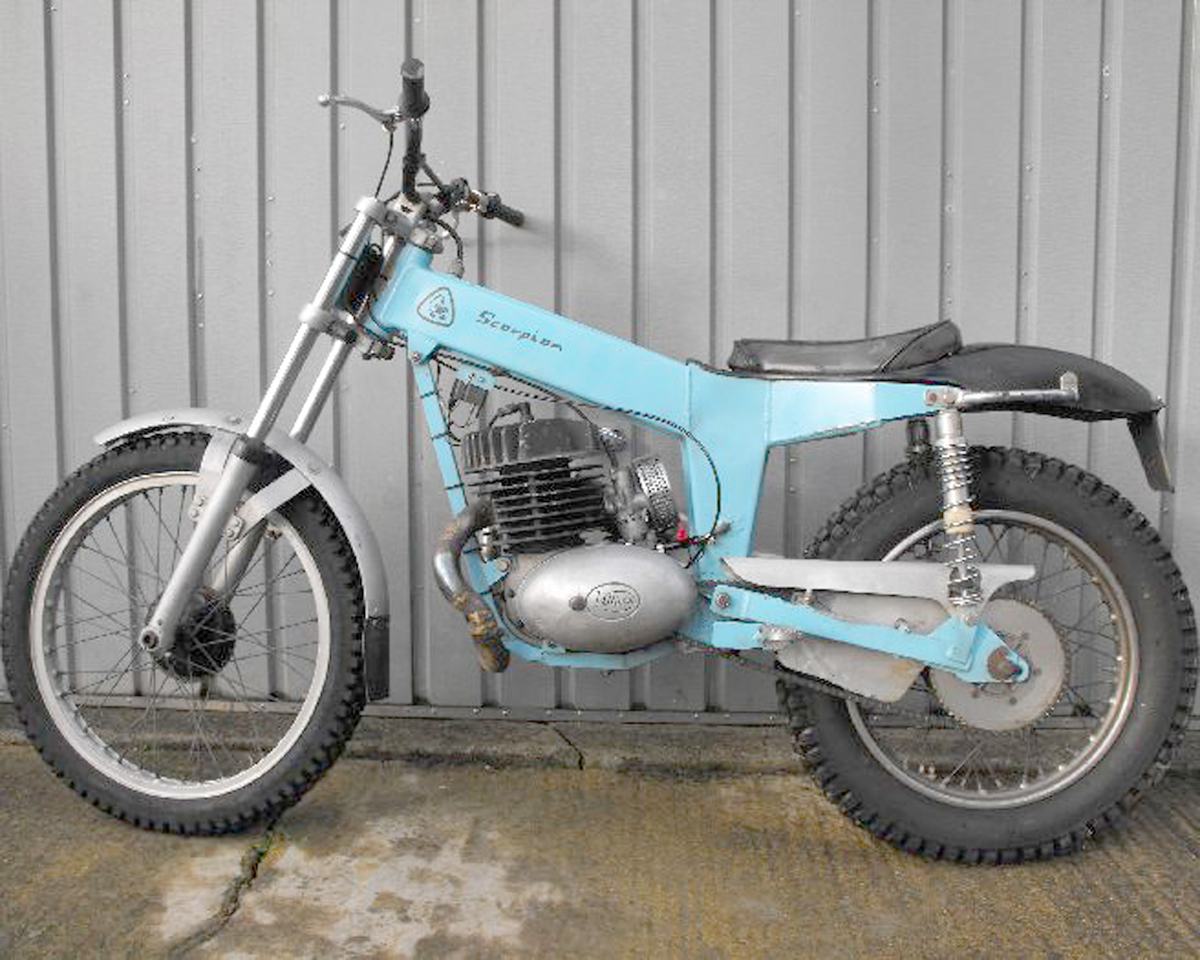
Not all of Northampton’s motorcycles came from the first half of the 20th century – there is one that first saw the light of day in the 1960s although it started life further south in Hertfordshire. In May 1963 Motorcycle Sport featured an article about a 26 year old man in Bishops Stortford who had made the courageous decision to design and manufacture a trials bike. Paul Wright, for it was he, worked on chassis development with what was said to be a “well-known firm of sports and racing-car manufacturer” – was it Lotus perhaps? – but his focus appears to have been more attuned to two wheels. In 1961 he had entered and won a Motorcycle News “Design a Machine” competition with a 300cc parallel twin two-stroke design and, based on his experience of riding a Francis Barnett trials bike, he seems to have been motivated to take his design flair several steps further.
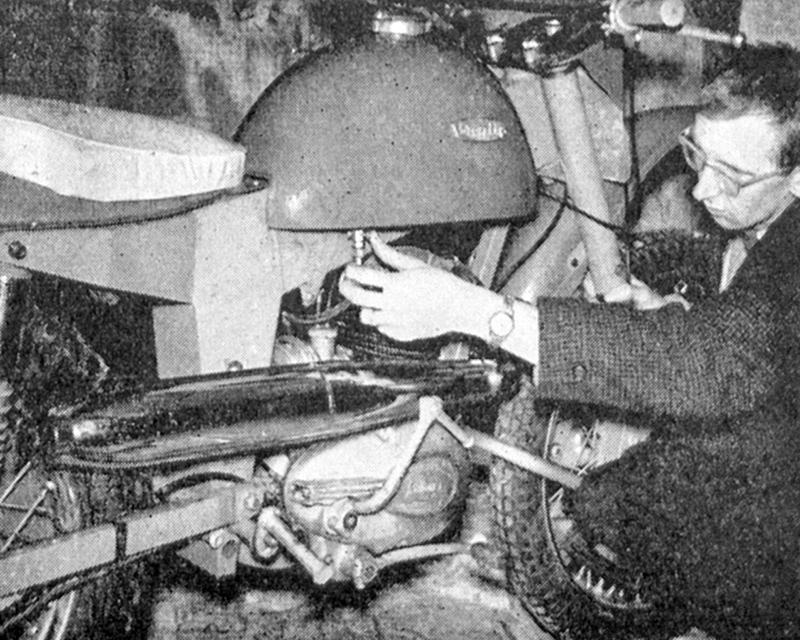
Paul Wright busy in his workshop
His main thrust was that trials machines needed to be lighter and so he opted for a beam frame fabricated from 18 gauge mild steel, with 16 gauge for the rear suspension outriggers, all of which had an overall weight of about 11lbs. This approach, coupled with much use of fibreglass for the front mudguard, tank and rear guard, all of which was manufactured by Chris Butler of Butler Mouldings Ltd. (better known for building trans-Atlantic racing yachts), produced a very light but strong trials iron. The engine was a Villiers 8E 197cc two-stroke to which Wright was proposing to fit a toroidal head that he was having produced which was said to add 5 mph, 15mpg and better acceleration at no cost to flexibility. Although the front suspension looked remarkably like a leading link Greeves unit, Wright had come to this design and layout independently, adopting a head angle of 62° which would be changed to 64° if and when he developed a scrambler machine. Hubs were alloy, other suspension elements came from Armstrong and the wheels were 21” at the front and 19” at the rear. As this was a start-up Wright did not have access to production facilities so the bike was designed so that it could be made up from parts made from outside firms working under contract and readily available proprietary parts. Moreover the intention was that it could be sold in kit form which attracted none of the sales tax that was applicable at the time.
Although Wright had not gone down the experimental model route and in fact proceeded straight to a prototype, the machine had not attracted any adverse comment from the several journalists who rode it. Then, two weeks after completion, it had been ridden by Chris Cullen in the Traders Cup Trial where the only problem was that the rear chain came adrift a couple of times. The Motorcycle Sport journalist felt that the Scorpion had a 50 : 50 chance of succeeding, noting that although Wright was very knowledgeable from a technical viewpoint and enthusiastic, he lacked “sufficient trade knowledge or competition experience” to appreciate the manner Joe Public would use his machine compared to press or competition riders.
Just before Christmas in 1963 the Motor Cycle published an article on the Scorpion by which time operations had relocated to Whitfield near Brackley, Northants. By now there were five models in the Scorpion range, all with 250cc engines, which comprised two trials and three moto-cross machines; they ranged in price from £223 2s 6d for the basic trials machine to £288 15s for the top-of-the-range moto-cross bike. As had been mentioned in the earlier Motorcycle Sport article all five machines could be bought in kit form and for these the prices ranged from £182 10s to £237 10s, presumably as a result of the purchase tax saving. Both trials machines used the Villiers 32A engine, the more expensive of the pair having its Villiers’ cylinder replaced with a “Parkinson alloy conversion” (Ron Parkinson, based at Marks Tey in Colchester, produced alloy competition cylinders and head kits for Villiers engine conversions as well as running a motorcycle business which had started in 1954). Two of the moto-cross bikes used Villiers 36A engine, the middle of the range having the Parkinson alloy barrel whilst the most expensive machine featured the Villiers Starmaker unit.
One person who rode the Scorpion in competition was Nick Holt from Rushden in Northants who was part of the Scorpion works team at the Scottish Six Days Trial in May 1964, his fellow team members being Chris Cullen and Laurie Spackman.
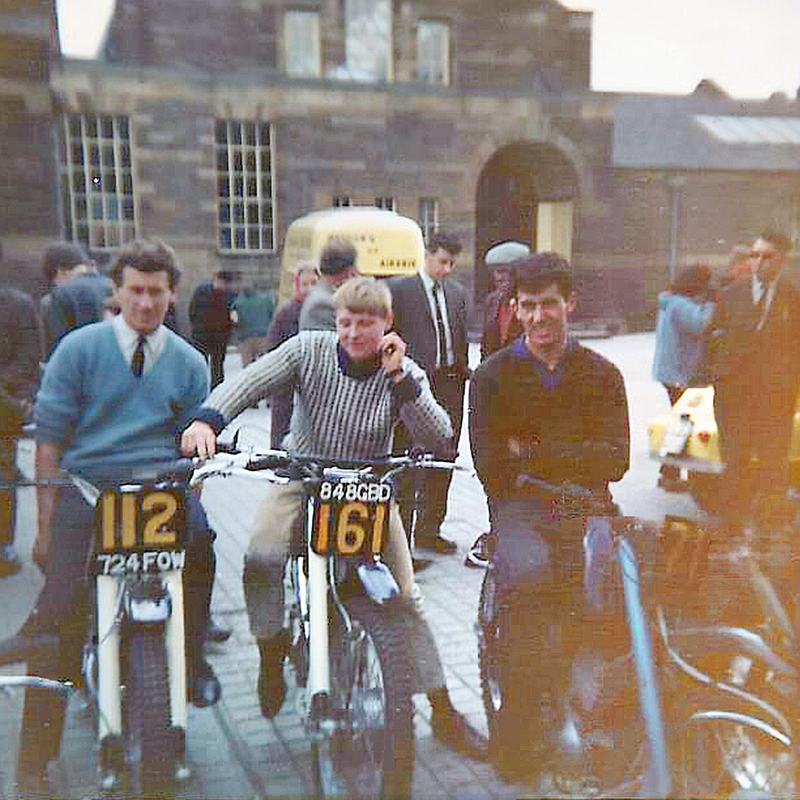
1964 - Nick Holt, centre, with Laurie Spackman and Chris Cullen
He made it through the first day of what was one of the wettest SSDTs then on record but a tooth had sheared off the gearbox lay shaft on the last section of Grey Mares Ridge. He managed to finish the day and get to Fort William but the gearbox had virtually disintegrated by the time he arrived, which had meant having to run alongside the bike for the last mile. This put him out for the rest of the week of the as competitors were not allowed to remove the main casing and they were all paint marked to make sure this rule was adhered to. Laurie Spackman had bad luck too – he sheared a flywheel crossing the Kincardine Bridge on the first day morning – but Nick believes that Chris Cullen finished with a special first which is quite something for a machine that had only been developed the previous year.
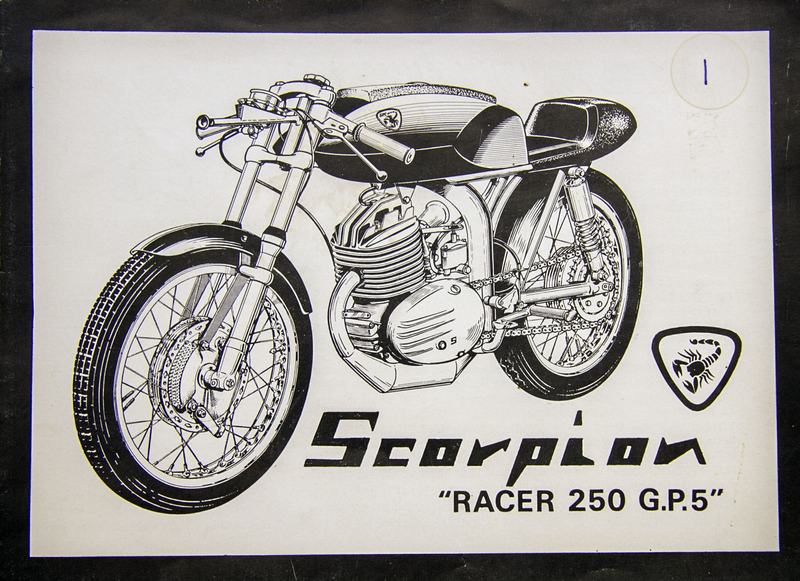
The Scorpion Racer
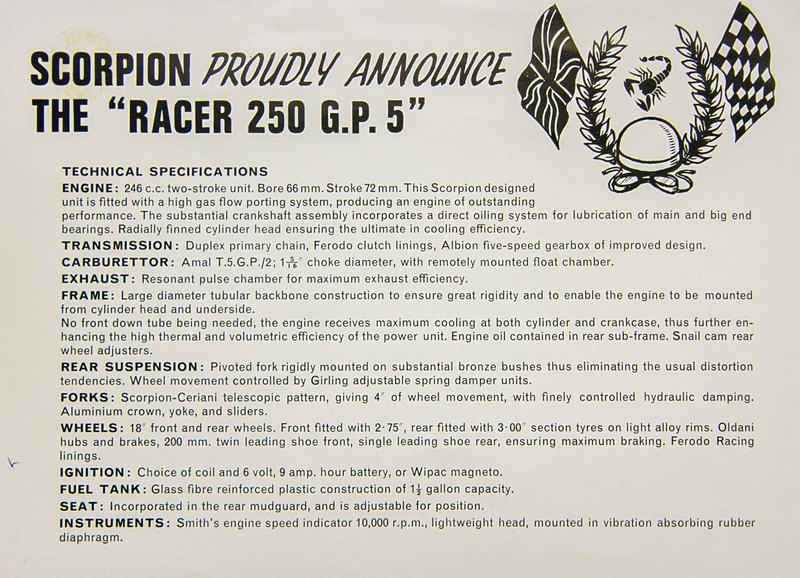
Scroll forward to 1965 and by now Scorpion has migrated to Northampton itself, located at Ashburnham Road near the county cricket ground. The manufacturer was confident enough to produce a brochure which proudly announced the advent of its “Racer 250 GP5” model featuring a 246cc Scorpion-designed engine with a high gas flow porting system, Albion five-speed gearbox, Amal carburettor and an exhaust with a resonant pulse chamber. Scorpion were still using a frame with a large backbone which avoided the use of a front downtube which was said to improve engine cooling whilst a rear sub frame held the engine oil. Forks were of a “Scorpion-Ceriani” design whilst the rear suspension was a pivoted fork employing bronze bushes. The 18” front and rear wheels featured Oldani hubs with a 200mm twin leading shoe brake at the front and single leading shoe at the rear. Fibreglass was also still a feature – the petrol tank was manufactured from the material as may have been the front mudguard. !”.
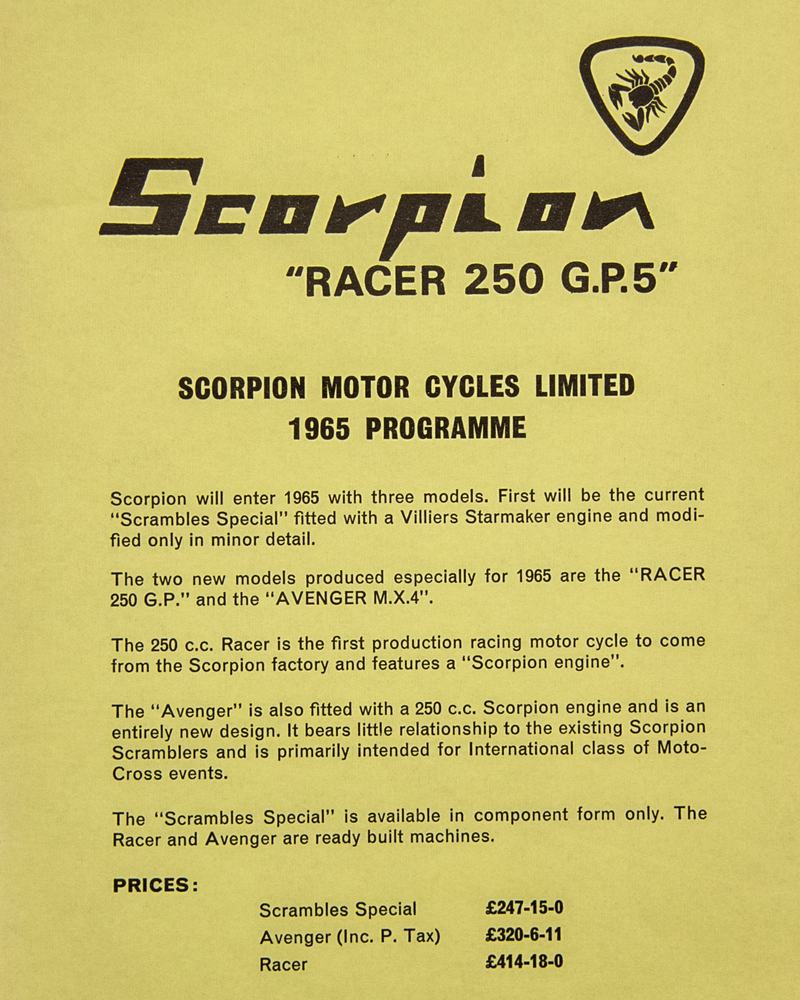
The brochure also detailed the Scrambler Special with its Scorpion-design stressed beam frame and leading link suspension wrapped around a Villiers Starmaker engine. Finally “and coming soon” was the Avenger 250 MX4 -“this machine is intended for use in national and international classes of Moto-Cross events and is not recommended for sale to any riders not of expert status”. Nick Holt recalls his last visit to the Northampton factory to sort out the machine for the Welsh three day trial only to find that Scorpion were also manufacturing the Daleks appearing in the Dr. Who television series. “I am pretty sure Paul Wright’s brother-in-law was the producer of the show at that time. I remember the surprise at seeing them in the “factory” - you definitely needed to be a small person to operate them!!”.
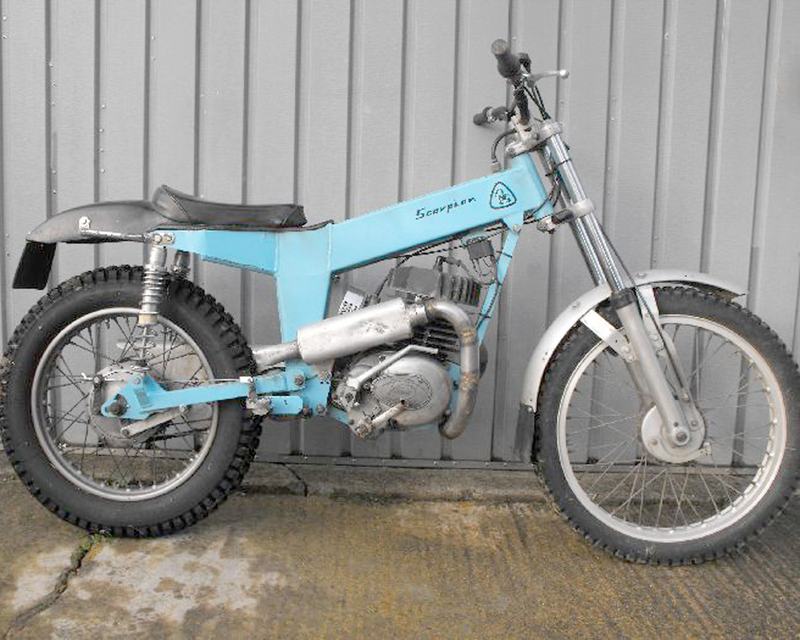
Ben Falconer's 1963 Scorpion
Scorpions are still ridden competitively today and one owner/rider is Ben Falconer of the West Gloucestershire & Dean Forest Motor Cycle Club. His Scorpion was acquired in 2010 from Dave Lomas who campaigned them in the 1960s and is cousin to Bill Lomas. Ben says “It is a genuine pre 65, though, with all major components dating from 1963” which was important as Ben had acquired it to ride in the pre ‘65 Scottish 2 Day Trial. His chance finally came in 2012 – his first pre ’65 Trial and only the second time he had ridden the Scorpion – so he did magnificently well to finish although a broken kickstart and two broken shocks led to quite a high score.
Scorpion production ended in 1965 from causes undocumented although Nick Holt recalls that there was a fire at the premises which must have caused major issues or even have been terminal. Whatever the case Scorpion disappeared that year and once again an innovative design sadly left the stage far too early. Who knows – if it had stayed the course Northampton may have been the home of Scorpion today and the town would still have a motorcycle manufacturing base.
Photo Details & Credits
Catalogue Extracts & Motorcycle Sport Article – VMCC
1964 Scottish Six Day Trial – Nick Holt
1963 Scorpion - Ben Falconer