
Princeps
A Northampton motorcycle with a limited production period and an interesting story.
The last of its kind
“First in time or order; the first, foremost, chief, the most eminent, distinguished, or noble” – this is the definition of the Latin word “princeps” so what better word to use to name a motorcycle. In 1902 the Princeps Autocar Company of Northampton began manufacturing motorcycles and a forecar in Abington Street. The company was also said to be owned by J.E. Hutton Ltd. of Shaftesbury Avenue and Regent Street who were also agents for Berliet, Mercedes and Panhard cars. John Ernest Hutton was the son of the Northallerton MP who was educated at Eton and Cambridge, trained as an electrical engineer and became a well-known motor racing driver.
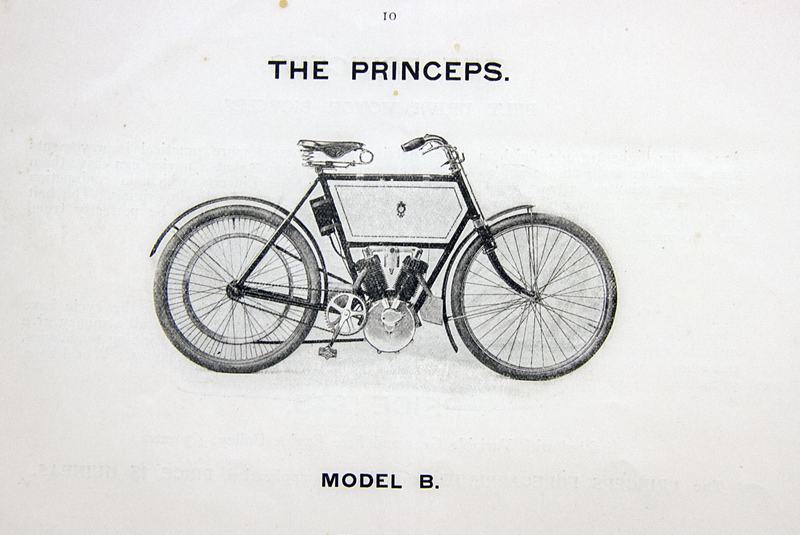
Princeps - the first v-twin? Extract from catalogue
Princeps, in tribute to their name, were arguably the first company to put a v-twin engine into a bicycle frame in 1902; the machine was initially, and imaginatively, known as the Model B and was advertised as producing 4hp. It featured variable gear and free engine belt drive and you could have belt or chain final drive, pedals being provided for light pedal assistance when the v-twin wasn’t quite up to it. Princeps were also advertising two other machines as early as February 1903 in the Motor Cycle under the banner “Princeps Leads the World”. Both had 2¼hp single cylinders, one with the aforementioned variable gear and free engine belt drive at £15 (say £5,400 in today’s money using the labour earnings measure), whist the other featured a free engine friction clutch and compensating spring chain drive at 50 guineas, say a whopping £19,000 today. There were also “many other improvements” including a mechanical inlet valve, a contact breaker without a trembler blade and an electric current governed by engine speed.
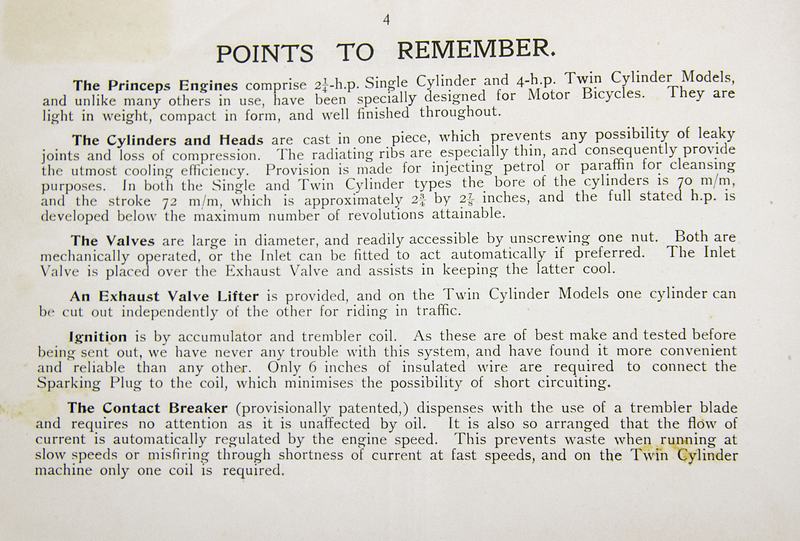
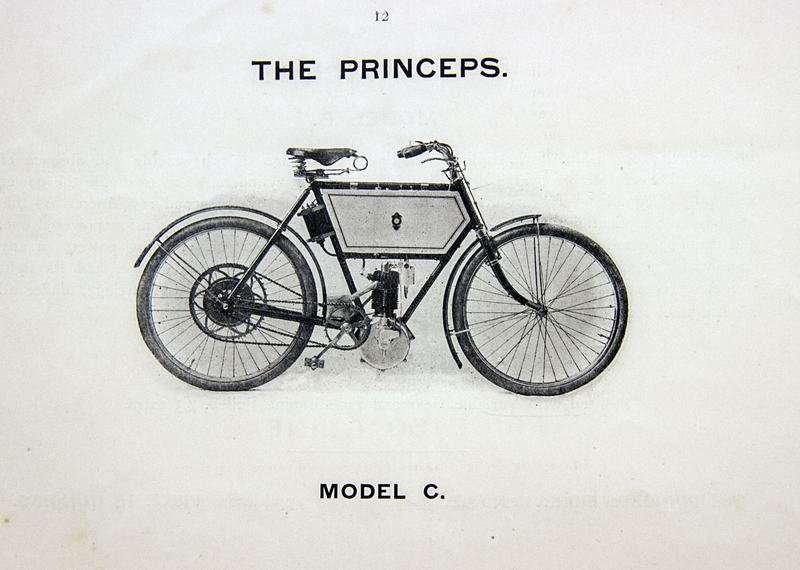
Extracts from Princeps brochure
Far more information was provided in the Princeps brochure which featured four models, two single cylinder and two v-twins, and where much was made of the innovations of the manufacturer “We claim always to be in the van of progress and our machines to be first in order of merit”. The cylinder had a bore and stroke of 70mm x 72mm giving a capacity of 277cc for the single and an unsurprising doubled-up capacity of 554cc for the v-twin. In all cases the cylinder and head was cast in one piece whilst the bolted together two-part crankcase was polished aluminium with a two-to-one gear case mounted on the outside; the latter also featured a pipe to relieve vacuum and compression whilst a waste oil cock was also provided. Flywheels were installed to ensure “exceptional smooth running at all speeds” and weighed in at 12¾ lbs. on the single and 14lbs on the v-twin. Lubrication of the engine was by a conventional pump operated by the rider and the piston was fitted with three rings to avoid fouling of the plug and valves. Fuel was fed to the engine via Princeps own design of polished aluminium float and spray carburettor with throttle and air regulator whilst the inlet-over-exhaust valve configuration was mechanically operated although the inlet valve could act automatically “if preferred”. In terms of the cycle equipment the frame was claimed to be light but strong, wheels had a 28” diameter and came with 2” Dunlop tires, rim-operating brakes were fitted to both wheels whilst the aluminium and stove bronzed lined petrol tank was good for 120 miles. The saddle was Lycett’s La Grande model, mudguards were wide with an extension piece over the front wheel and each machine came with a set of tools, a pump and an oil can.
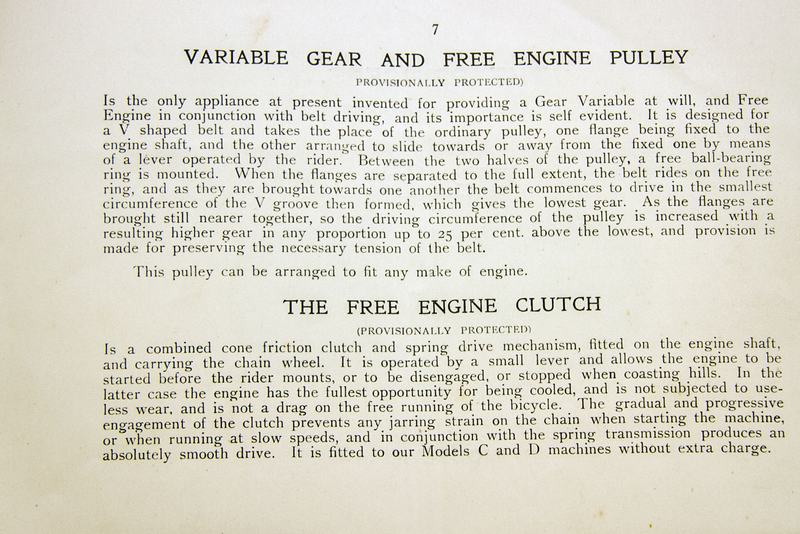
Variable gear and free engine pulley extolled
Much was made of the Princeps innovation of the variable gear and free engine pulley – claimed to be “the only appliance at present invented for providing a Gear Variable at will” – and the free engine clutch. The machine was apparently easy to ride as the spark advance and exhaust valve lifter were both operated by one lever on the handlebar whilst the electric current was broken by a slight pressure on the front brake lever. Therefore, in theory, the engine could be controlled and brakes applied without the rider taking his or her hands off the handlebars.
The address for telegrams but no mention of J E Hutton
However all is not as it first appears. Local knowledge is that not only did the Princeps brand exist before 1902 but the company was then owned by a Northampton concern. If you look at the Princeps brochure, telegrams were to be sent to Arnott, Northampton; Arnott & Son were a firm of oil and colour merchants located at 46 Abington Street and thought to be the actual owners. If you then have a look at the Sunbeam MCC Pioneer Register you will find a single entry for Princeps dated 1901. Princeps closed operations in 1905 and J.E. Hutton Ltd. was wound up in 1908; 46 Abington Street went on to be occupied by Woolworths and Tesco.
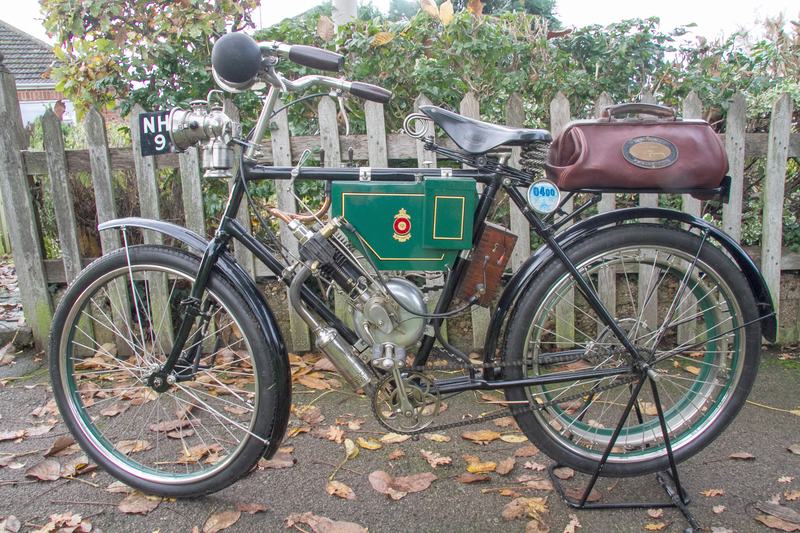
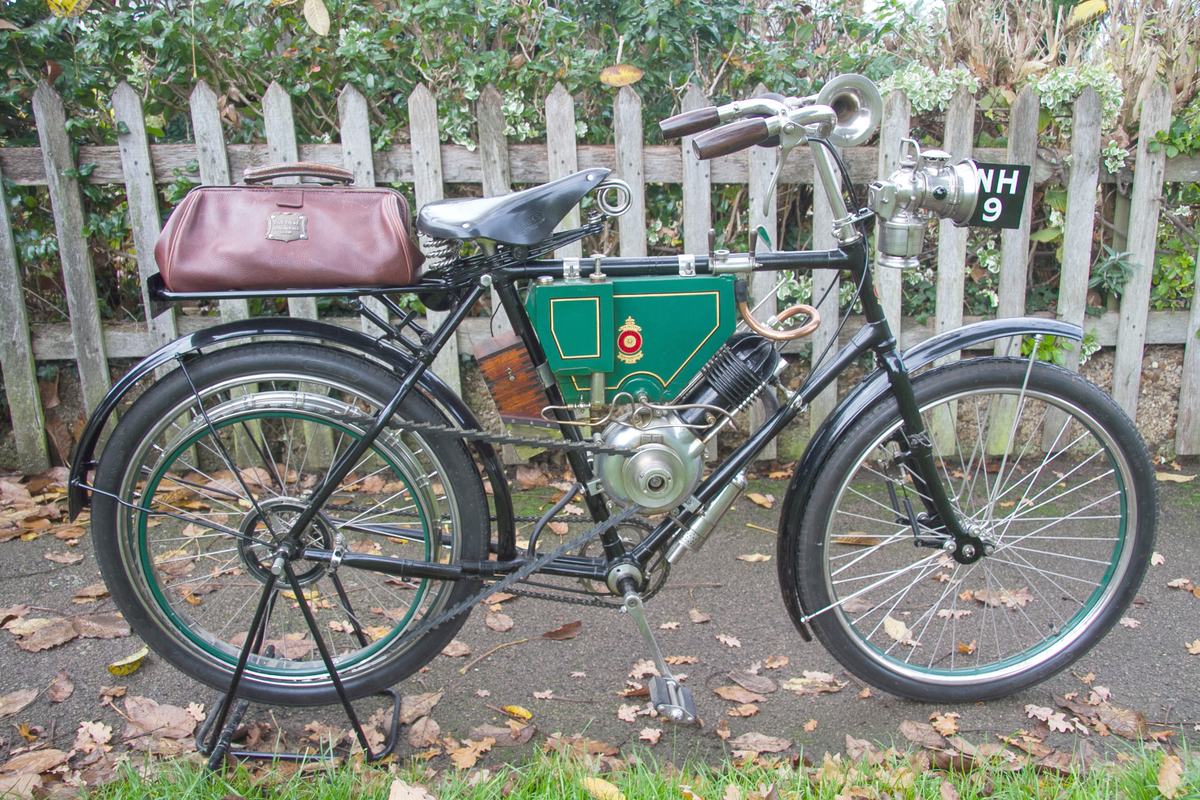
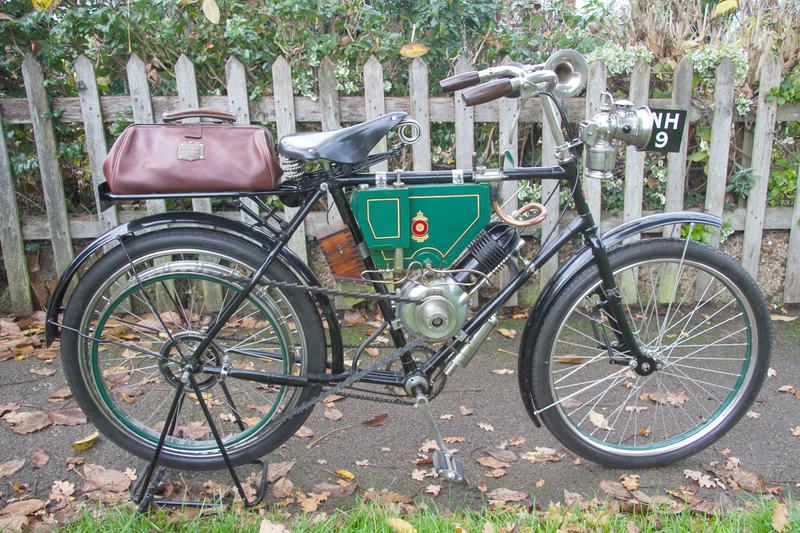
It is believed that there is only one Princeps still in existence and it was owned by one of the Northampton section members until he sadly passed away. Fortunately he was kind enough to allow it to be photographed so there is a record of it today. . As you will see the machine here differs fairly significantly from those in the period brochures and in fact has a capacity of 211cc with its single cylinder having the same bore and stroke as that of the Levis Popular which appeared some ten years later. It was acquired at auction after it had been found in a garage loft in Bournemouth, after which its new owner restored it to its present magnificent condition. Some fairly major work was required including replacing a cracked head which was beyond repair; the owner commissioned two new heads to be manufactured on the basis, as he said, that “two heads are better than one!”
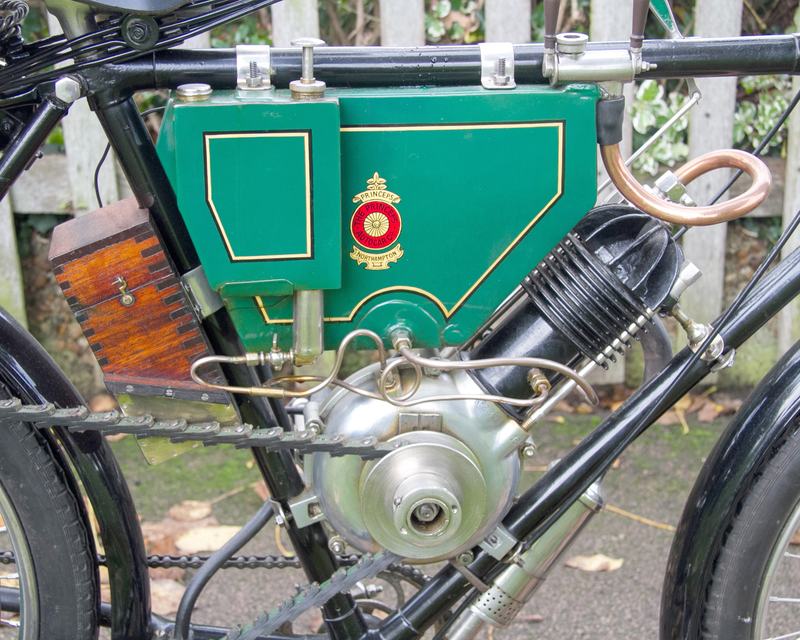
Over the years it has not only taken part in the Pioneer Run but also been ridden to Holland where a strong headwind stopped it in its tracks. It is apparently very hard work to ride with a lot of paddling and walking being involved as well as very poor brakes making retarding progress something of a chore. You will agree that this unique machine is a huge credit to its former owner and it is excellent that this piece of Northampton’s heritage has survived so well into the 21st century.
Photo Details & Credits
Catalogue Extracts – VMCC
Advertisements – VMCC & Mortons Media
Extant Machine Photographs – Owner/Author