
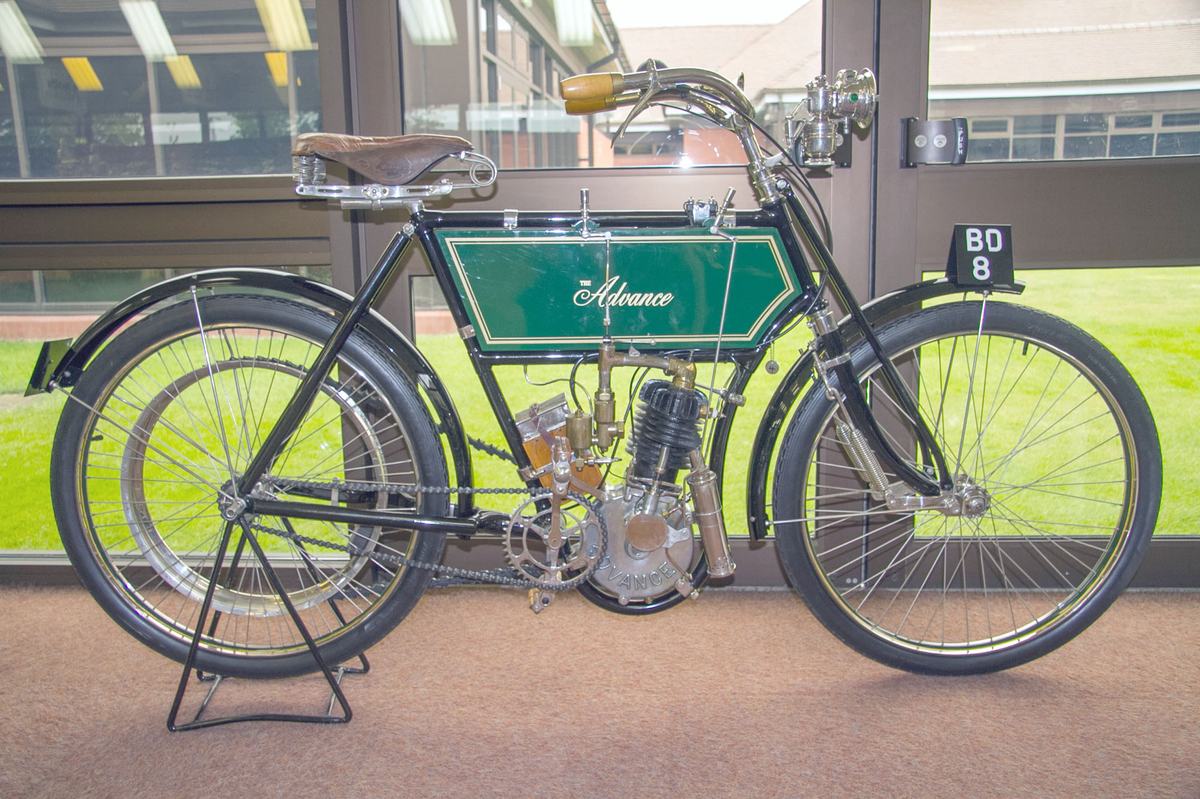
Advance
Advance was a Northampton Manufacturer in the early part of the 20th century
The marque was produced for a short period between 1902 and circa 1912.
If you’re trying to get your brand to the top of the pile it does help if it has a name that begins with “A” but whether this was in the minds of Messrs. Douglas Herbert Gainsford and Frederick Smart, Northampton men both, when they founded the Advance Motor Manufacturing Company in 1902 is open to debate. As was often the case it is thought that the two first had been involved with a bicycle shop in Abington Square which also hired early motorcycles with wicker sidecars. In 1903 the duo became a triumvirate when Joseph Charles Power of Watford joined the company and things started to happen when they developed a 2¾hp single cylinder engine which they inserted into a motorcycle that same year. This was soon superseded by a 3hp version, an enlarged 3½hp single and a v-twin which produced 6hp – essentially each cylinder of the latter having the same bore and stroke as the single. In an early catalogue the firm was offering all three engines in motorcycles, including a lady’s model, as well as tri-car and forecar models which featured the v-twin.
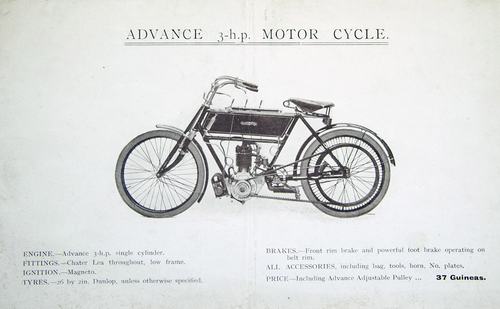
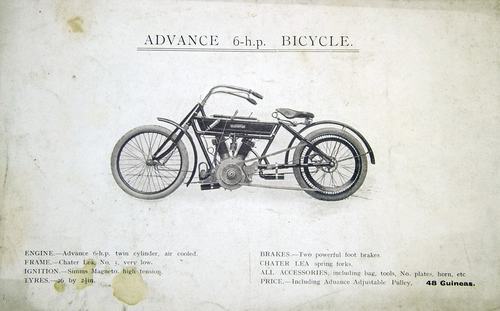
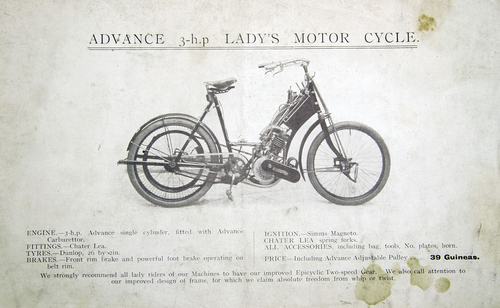
Extracts from Advance catalogue
These engines had an automatic inlet valve and a one-piece cylinder head and barrel. Chater Lea provided the frame, front forks and, in the case of the lady’s motorcycle, the “fittings” (whatever they were); ignition was by magneto and brakes acted on the rim although the v-twin was said to have two “. All four models make mention of the “very low” frame, which was to be a distinguishing feature of Advance motorcycles, and they all came equipped with the “Advance Adjustable Pulley” which had been invented and patented in 1907, essentially a device to aid the ascent of steep hills. Finally the lady’s model contained a strong recommendation that gentlewomen should really opt for Advance’s Epicyclic Two-Speed Gear to be fitted as part of their purchase. Why ladies should feel the need for this piece of equipment is not revealed – perhaps Advance were aware of the increasing buying power of the female market. Prices started at 37 guineas whilst that 6hp v-twin would set you back 48 guineas; the Bank of England Inflation Calculator puts this at about £4,250 and £5,550 respectively in 2026 terms. 1 pound (£1) to 30 shillings (£1 10s.) per week, or roughly £110 to £165 per year, depending heavily on skill level, gender, and sector.
On 27th March 1907 the Motor Cycle revealed that they had paid a visit to the Advance works, driven there by Mr. Power himself in a 5hp light tri-car which was fitted with a “remarkably comfortable and well sprung body”. The reporter had been greeted with the sight of the aforementioned lady’s model fitted with that all-important two-speed gear as well as the motorcycles and tri-cars, with both air and water cooled engines, busily being built. Lots of the adjustable pulleys were being turned out too and apparently they had been “giving great satisfaction, and are very much in demand”
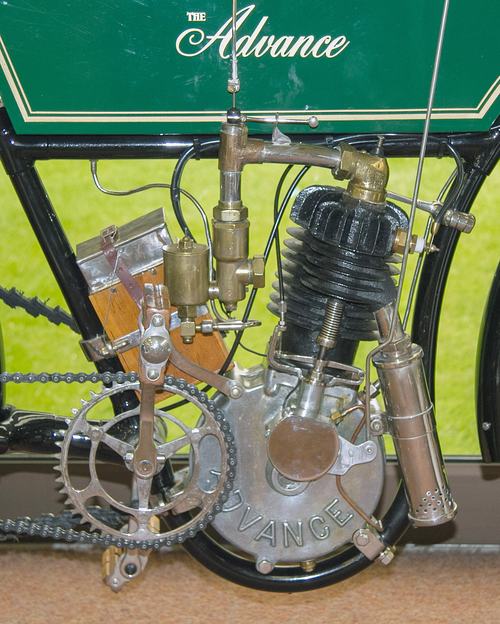
Advance at the National Motorcycle Museum
The adjustable pulleys were not the only thing that Advance did that was in demand; their products were seen as extremely reliable and not only were they supplying Enfield manufacturer Duzmo with their engines, but they also supplied components for polar explorer Robert Scott’s motorised sledges as well as Handley Page’s Blue Bird monoplane. Moreover the Zenith Gradua gear, patented by Freddie Barnes in 1907, was manufactured by Advance from then until 1923. In 1907 their catalogue of engines included both air and water cooled units producing 3hp, 6hp and 9hp which were manufactured at their factory in Louise Road and handsome pieces of kit they were too.
In 1912 the operation moved to new premises on the corner of Kingsthorpe and Balmoral Roads and it was at about this time that Advance stopped manufacturing motorcycles and tri-cars. As to why this occurred is open to speculation but it’s possible that the firm wanted to focus on more profitable lines. One of these could well have been in alliance with its sister company Standard Valves which was formed midway through WWI to meet the ever increasing demand for valves employed by the motor industry.
By 1922 Charles Power was in control of the company and appeared to have become a man of some standing in Northampton who had married opera singer Clara Streeton and was also an enthusiastic freemason. Advance was sold to Sheepbridge Engineering Company in the 1950’s and through a series of corporate acquisitions is now part of Partco Autoparts Ltd. which is still around in Northampton today as well as several other locations in the south of England. Should you wish to see an Advance motorcycle in the flesh, as it were, then you need go no further than the National Motorcycle Museum where they have an example of the original 2¾ single cylinder model with the legend “Northampton” emblazoned on the drive side of the engine.
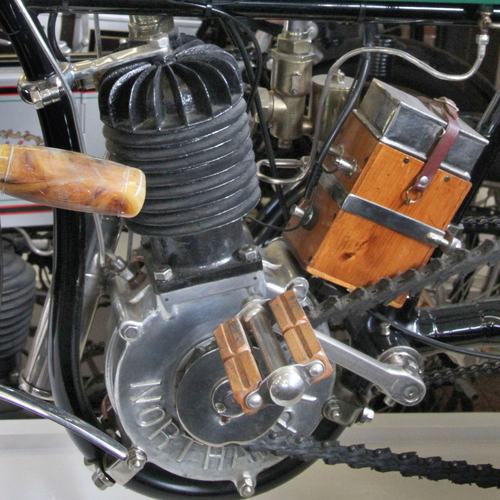
"Northampton" proudly displayed on the drive side
Photo Details & Credits
Catalogue Extracts and Advance engine photos – VMCC
Charles Power and Advance factory photos – Northampton Chronicle & Echo
Extant machine photos – National Motorcycle Museum/Author