
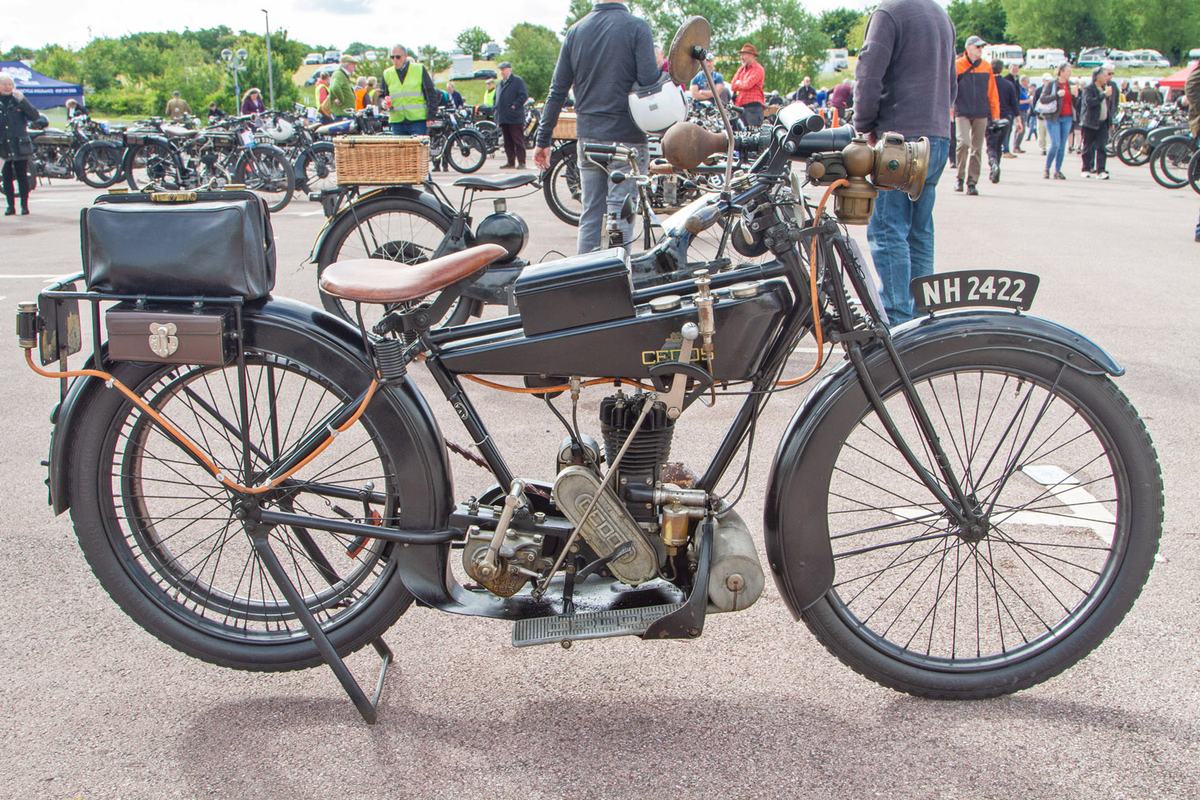
Cedos
Perhaps the most well-known of the Northampton marques.
The Cedos story starts in 1887 when Oscar Edwin Hanwell was born to Herbert and Anne; then in 1890 Oscar was joined by a brother, Cedric Harold. In 1891 they were all living in Alfred Street in Northampton with Herbert working as a house painter and decorator; 10 years later they had moved to Abington Street, Herbert had added plumbing to his talents and described himself as an employer; however the census return is perhaps understating his talents. It is said that he was responsible for decorating many of the country houses in the area including Althorp House, the home of the Spencer family, where he is said to have “wrought beautiful transformations.” Moreover he registered a number of patents for gas pendants which he had invented himself so he was by no means a simple paper hanger and gas fitter. By 1911 Oscar was still living at home but was employed as a commercial clerk in a gas fittings business, presumably his father’s; Cedric, on the other hand, was living in a boarding house in Coventry where he was employed as a mechanic in motor manufacturing. During WWI Cedric served as a 2nd lieutenant in the Royal Army Service Corps, apparently having been commissioned from staff sergeant rank. There is no record of Oscar having served although he did get married in December 1914 at which time he was described as a decorator again perhaps an understatement of his talents.
In May 1919 the brothers submitted a patent for improvements in spring forks for motorcycles, essentially a housing with a spring under compression which allowed backward, forward and up and down movement. Then in October a second patent was applied for in respect of improvements to motorcycle under-shields. In the same month as the second patent is applied for we see a two page article in the Motor Cycle heralding the Cedos 2½hp motorcycle - “An entirely new and well-designed lightweight embodying many practical features.” What has this to do with Oscar and Cedric – or should I say CEDric and OScar? Yes – the brothers had gone into motorcycle production using a company which eventually became Hanwell & Sons (Components) Ltd. How had this been achieved so quickly? Well in the London Gazette of January 1919 there is a notice to all concerned that Hanwell Pendant Company Ltd, presumably Herbert’s concern, was to amend its objectives; the first change was to acquire and continue Herbert’s gas fitting business at 35 Abington Street. The second, and presumably new, objective was to “carry on the business of general engineers and motor engineers and mechanics, including the - manufacture and dealing in motor cars and vehicles, motor and other cycles, aeroplanes and other aircraft….” As such the premises as well as some of the engineering knowledge and tooling may well have been readily available from Herbert’s business. There is also a possibility that some of the engine design may have been courtesy of a Minerva engineer who was working with Advance in Northampton and who may have also helped the brothers Hanwell to accelerate the time to market. Supporting this premise is a later report which makes mention of a Mr. E Smith, working with Cedos, who was “for a long time associated with a concern manufacturing a well-known machine possessing a high pre-war reputation”. This may well have been Ernest Smith who became the works manager for Cedos.
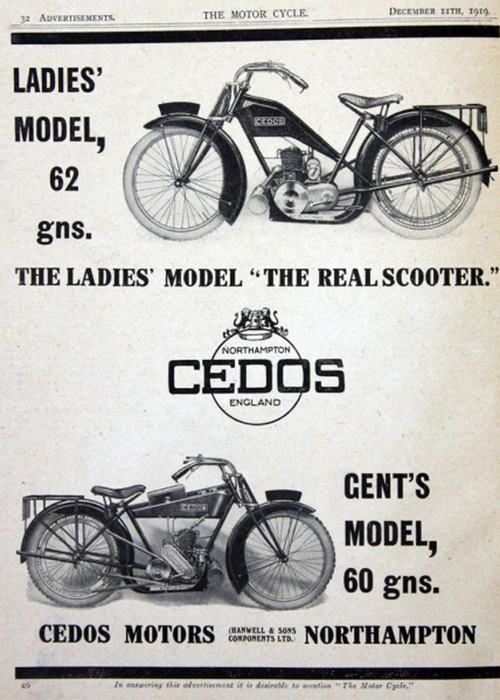
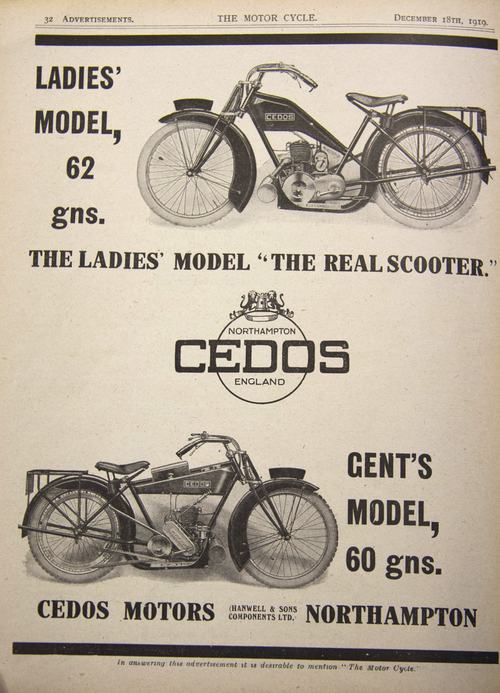
Extracts from Cedos catalogue
In any event, despite the fact that only one motorcycle had been built, on October 19th the Motor Cycle was very complimentary, describing it as “one of the most carefully thought out lightweights we have yet been privileged to examine”. The machine had been designed so that everything that needed to be brazed and welded to the frame had been, thus reducing those irritating rattles. Much was made of the single cylinder, two-stroke engine with its bore and stroke of 62mm x 70mm giving a 211cc capacity – there was nothing unusual or unique about it apart from the fact that “all parts are beautifully made”. The carburettor was also said to be very ingenious although Motor Cycle were precluded from explaining it in any detail as the patent was still pending. Suffice it to say that it embodied a variable choke that enabled the engine to run extremely slowly and two-stroke regularly. The two-speed gearbox design with its handlebar mounted thumb lever change, also came in for praise as the drive chain tension could be adjusted by simply slackening off a single bolt and rotating the gearbox through a few degrees with a tommy bar. Final drive was by belt and much was made of the under-shield which started life at the bottom of the rear mudguard, spread out either side of the aluminium footboards and terminated as a shield to prevent the rider being sprayed with mud. Bizarrely the Hanwell boys didn’t believe in front wheel brakes; instead two belt rim brakes were provided to the rear wheel, one acting on the outer part operated by the left heel and the one on the inside by the right toe. Finally the colour scheme was purple, the paint applied over a coating of zinc phosphate (a rust-proofing process which led to the metal being “Cosletised”), with the frame being a slightly deeper shade than the tank. In that purple had, from time immemorial, been the colour of royalty and far from cheap perhaps Cedos were instilling their quality message subliminally with this paint work. Prices had not been set but were going to be “reasonable” and deliveries were due to start the following January.
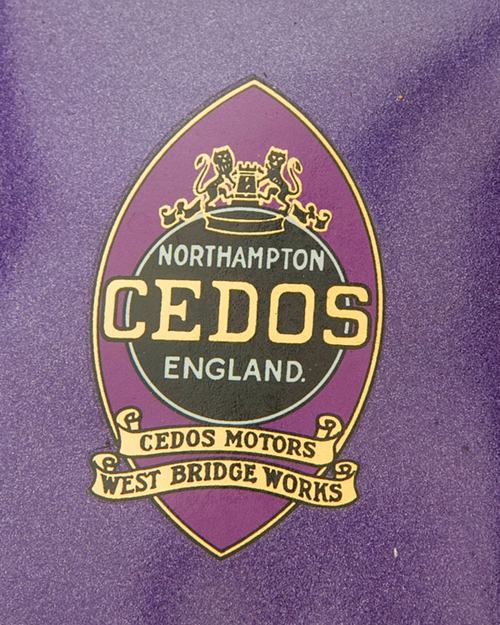
Cedos and the purple paint
Two further positive reports appeared in the Motor Cycle before the year ended. You have to hand it to Oscar and Cedric; in the space of one year they have applied for at least three patents, set up a production line, manufactured their first motorcycle and managed to get four favourable reports in one of the two main motorcycle publications of the day. Positive press coverage continued, new models introduced and in 1921 Cedric Hanwell won a Gold Medal in the Scottish Six Days Trial aboard one of his Cedos machines. At about this time we come to the first problem, unsurprisingly financial in nature given the rapid expansion of the company. Trading was suspended and also, presumably, manufacture of the motorcycles; there was an injection of cash into the company and, at about the same time, Herbert sold his house, possibly to assist with finances. Regrettably for Oscar and Cedric it was all for naught. However all was not lost f or as, whilst trading recommenced on the 7th October 1922 in the new guise of Cedos Engineering Co. Ltd., the only employee – and now a director - to survive from Hanwell Components was Ernest Smith and manufacture moved to West Bridge in the St. James area of the town. In September 1922 the Motorcycle had featured a one page article about Ernest Smith’s new engine design, featuring the detachable cylinder head, which was to be introduced for 1923 at the Paris Salon and Olympia with a three-speed gearbox. The article started with the sentence “The Cedos two-stroke was obviously too good to go under when the company went into liquidation.”
In May 1923 the Motor Cycle announced that Cedos would be entering the TT with two identical ohv Blackburne-engined 350cc machines and one 349cc side valve. All would be provided with three-speed Sturmey Archer gearboxes, Amac carburettors and Druid forks, a complete move away from the ethos of manufacturing everything in-house. The rider was Norman Black and he finished fifth in the Lightweight but failed to complete the Junior and thus ended the only Cedos TT attempt. Again new models were introduced and there was another Gold Medal win for Cedos in the ACU six day trial in the Lightweight class ridden by Mrs. Edith Spokes. October saw the announcement of the 348cc Bradshaw-engined model going into production with both the gents and Ladies’ models selling for £57 10s and £60; C.E. “Titch” Allen felt that Cedos should have advertised it “as the 350 that goes like a 500”. Of course it was all too good to last. In 1925 suppliers started asking for cash with any orders arriving from Cedos whilst significant discounts were being offered by both the company and its network of dealers. In September a notice of a Winding-up Order appeared, once again in the London Gazette, for the Cedos Engineering Company with the Dunlop Rubber Company as the petitioner.
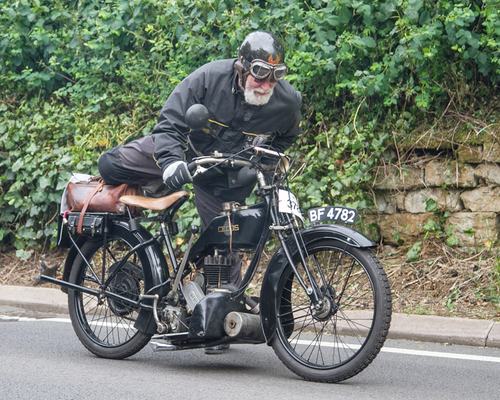
Cedos struggling somewhat on Sunrising Hill
Still every cloud has a silver lining and Cedos’ end was not quite yet in sight. A triumvirate of three local business men founded a new company called Cedos Motorcycles Ltd.; presumably they had acquired the assets from the liquidator. Two of three men were not exactly versed in the manufacture of motorcycles; John Adkins was a decorator and builders merchant whilst Albert Neale, who ran a bingo hall in Luton, became the sales manager. The third was Percy Spokes, an agent for the marque and keen Cedos enthusiast who owned his own motorcycle shop in Henry Street and eventually became known as Northampton’s “Mr. Motorcycle”. He was also husband of the aforementioned Mrs. Edith Spokes, both of whom were Cedos enthusiasts. the “new” company was set up in February 1926 with a share capital of £2,000, which seems rather low, and premises were taken in 11 Brunswick Place. The 1926 Cedos range featured five lightweight models priced between £25 - £35, three with final belt drive and two with chain, all had the Cedos manufactured 247cc two-stroke engines, two models had three-speed gearboxes from Sturmey Archer but none had a front brake – talk about keeping up a tradition. There were also two 350cc four-stroke machines, one with a Blackburne engine (£60 10s) and one with the oil-cooled Bradshaw unit at £55 10s (or £71 15s with a sidecar); both had front brakes. Finally there was the 247cc Queens (Ladies’) Model with all chain drive, three-speed gearbox, kick-starter and a finish described as “De Luxe” for £50. August 1926 saw Cedos earn yet another Gold Medal, this time in the International Six Day Trial, at an average of 38mph.
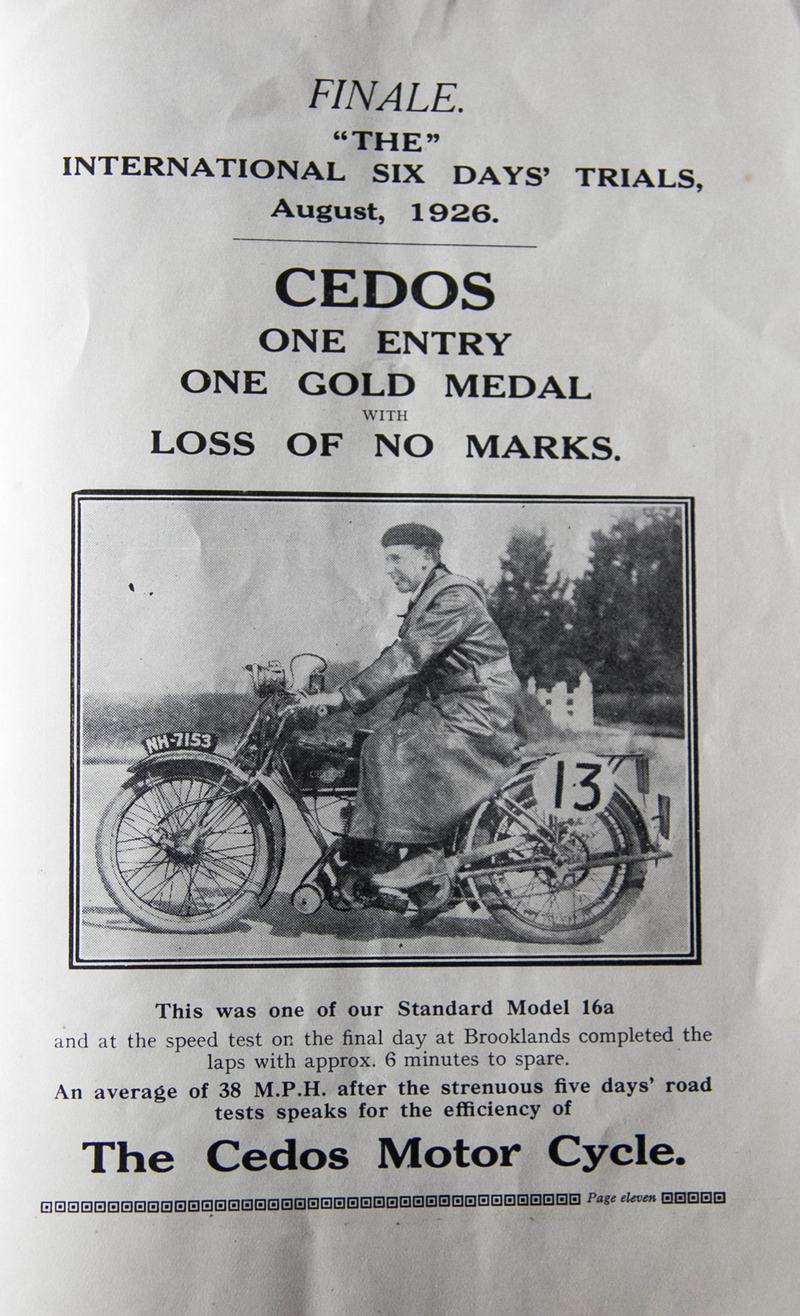
In 1928 two new lightweights were to be added to the range but all was not well at Cedos. . Despite what Cedos may have been advertising in the press or telling journalists, there are no known examples existing from after 1926 and it is said to be doubtful if any machines were sold at all in 1927 whilst none at all were manufactured in 1928. Whilst the New Cedos Engineering in St. James Road continued until the 1970s, Cedos Motor Cycles Ltd. was struck off the Companies Register in January 1932. There are thought to be about 18 Cedos machines left, most in the UK although three are thought to be in Holland (where many were sold and specific catalogues were produced for this market), and one in Norway. There is also one in South Africa which is known to have taken part in the 700km Durban to Johannesburg Run, quite something for a 1920s machine.
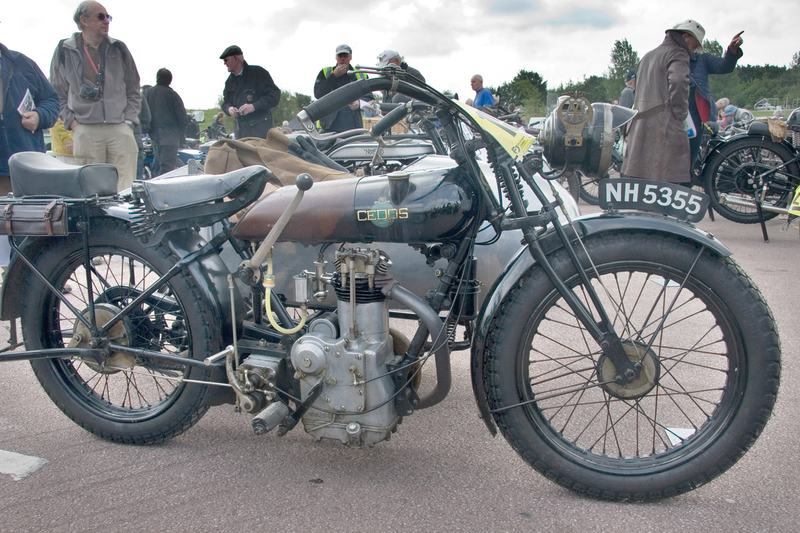
Percy Spokes' oil cooled Cedos outfit at the Banbury Run
Photo Details & Credits
Catalogue Extracts – VMCC
Motor Cycle & Motor Cycling Extracts. Advertisements – VMCC & Mortons Media
Photographs - Terry Spencer and Author